
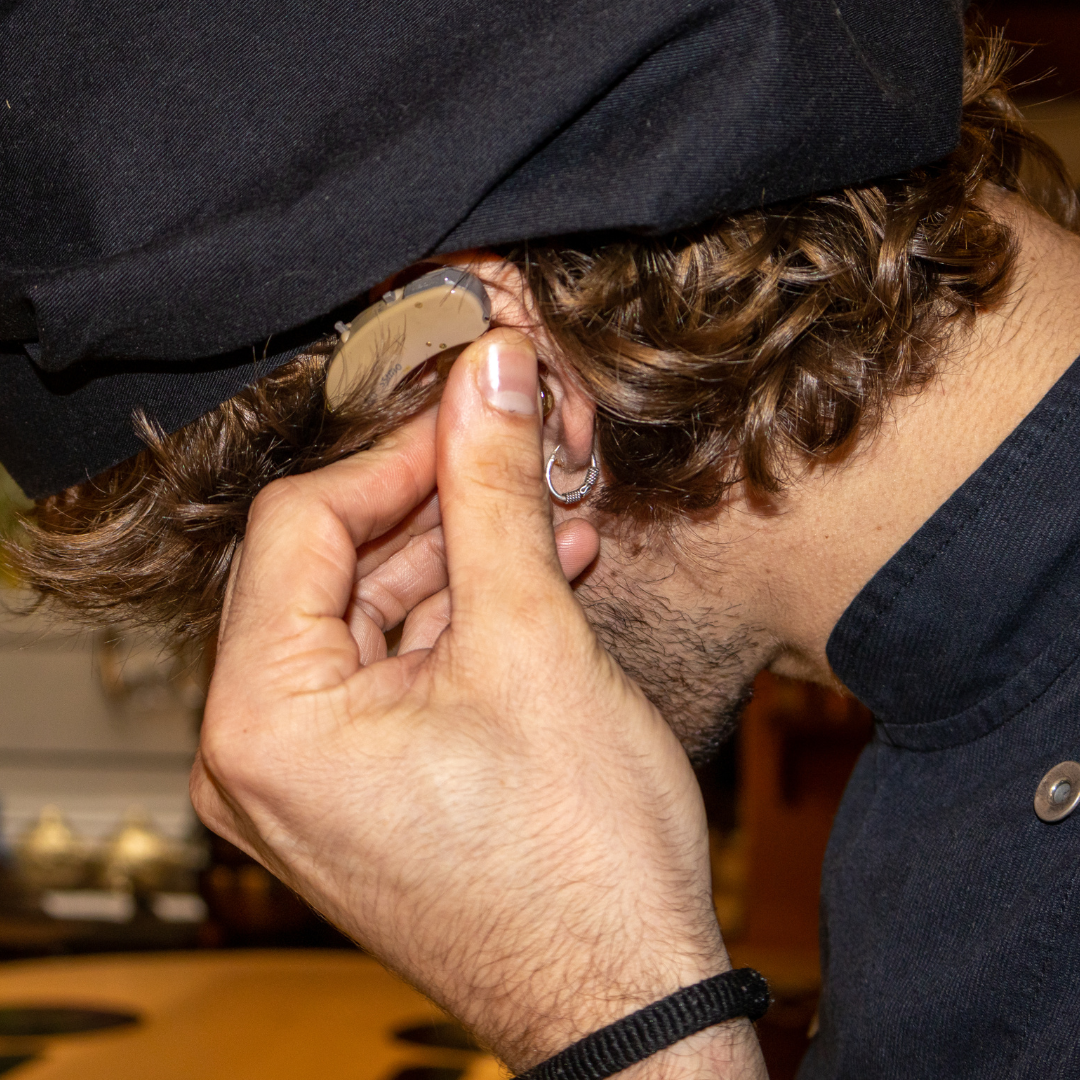
Active restaurant conversations are frequently hard to decipher when surrounding background noise clashes with your hearing. Our clinical team can evaluate hearing across quiet settings and background-noise environments to pinpoint specific auditory challenges. After diagnosing the source of your difficult hearing, we design targeted interventions tailored to your listening needs.
Why Do I Hear Well in Quiet but Struggle in Restaurants?
Quiet rooms provide a favorable signal-to-noise ratio, meaning a speaker’s voice is much clearer than the sounds around it. Dining rooms present an unfavorable acoustic reversal of this dynamic. Cross-talk, ambient music, dishware noise, and harsh acoustic reverberation interfere with speech clarity, forcing your brain to labor to extract the target voice.
These communication barriers frequently indicate high-frequency hearing loss, central auditory-processing disorders, or age-related sensorineural changes. Visual limitations from low lighting, cognitive fatigue, and sitting farther away from conversational partners amplify speech degradation. It is common to display normal baseline audibility on conventional hearing tests while failing comprehensive speech-in-noise testing. Experiencing speech-recognition struggles in noisy dining venues warrants a formal audiological evaluation regardless of seemingly normal quiet hearing.
Diagnostic Protocols for High-Frequency Hearing Loss
Diagnostic assessment begins by documenting specific listening breakdowns, recreational noise exposure, tinnitus symptoms, medications, and hereditary auditory patterns.
Diagnostic pure-tone audiometry establishes the softest auditory thresholds you can perceive across standardized frequencies via air and bone conduction pathways. High-frequency loss often creates an audiogram pattern in which thresholds become poorer as pitches rise. Additional testing may include tympanometry to assess middle-ear function and word-recognition testing to measure speech understanding.
Because a quiet booth does not recreate a busy dining room, speech-in-noise testing can add valuable information. This procedure gauges speech-discrimination accuracy while competing multi-source noise becomes incrementally louder. In combination, these diagnostic metrics reveal whether communication hurdles involve audibility thresholds, speech discrimination, neural noise management, or mixed conditions.
Understanding Auditory Processing Disorders in Noisy Environments
An auditory processing disorder compromises how the central auditory pathways and brain decode incoming acoustic information. The physical ear mechanisms may capture tones correctly, but the central brain pathways struggle to filter competing inputs, parse similar consonants, or interpret rapid speech. We first evaluate peripheral hearing and then determine whether an individualized auditory-processing test battery or referrals to other professionals are appropriate.
How to Improve Speech Clarity in Challenging Acoustic Environments
Minor environmental adjustments can boost speech acoustic signals and supply critical visual lip-reading cues. Prior to dining, choose venues known for lower noise levels or schedule meals during quieter dining hours. Dining locations utilizing sound-absorbing elements like booths, felt panels, window curtains, and carpet offer better acoustics than high-ceilinged rooms with hard surfaces.
Practical seating strategies in the dining room:
- Ask for seating positioned far away from open kitchens, noisy bar areas, ceiling speakers, and large parties.
- Sit with your back near a wall to reduce noise coming from behind you.
- Face your conversation partners in good lighting.
- Keep the distance between speakers as short as comfortably possible.
- Turn your better-hearing ear toward the specific speaker you want to hear most clearly.
- Ask speakers to reword the specific phrase you missed rather than repeating their initial wording.
- Verifiably confirm essential conversational facts instead of bluffing comprehension.
- Take brief listening rests outside or in quiet hallways when mental fatigue emerges.
- Encourage friends to enunciate clearly while maintaining an even, normal conversational tempo.
- Shouting can distort speech and does not necessarily make words easier to understand.
Advanced Technology for Hearing in Background Noise
Optimal technological solutions depend entirely on the etiology of your symptoms, target acoustic spaces, and whether measurable hearing loss exists. Prescription hearing aids fitted by an audiologist leverage directional microphone arrays, advanced digital noise reduction, and dedicated restaurant programs to focus on frontal speech while dampening background sound. Maintaining realistic expectations remains essential, as no auditory device can isolate conversation by removing all surrounding voices.
Pairing your devices with a remote wireless microphone generates a substantial improvement in the direct signal-to-noise ratio. Positioned near or clipped to the speaker, the device transmits raw speech audio directly to paired hearing aids or external listening receivers. This reduces the effects of distance and surrounding noise.
Further practical hearing technology options include:
- Multi-directional table microphones designed for small dinner gatherings
- Telecoil components connecting directly to public hearing-loop systems
- Mobile phone live-transcription apps offering real-time conversational subtitles
- Advanced hearables incorporating assistive directional listening programs
- Acoustic sound-meter apps and dining review directories that score restaurant noise
We can compare options, confirm compatibility, and teach you how to use the selected device.
How an Audiologist or Physician Can Improve Hearing in Noise
Undergoing a formal hearing evaluation takes your care beyond the limited baseline of hearing adequately in quiet spaces. We assess the specific acoustic settings, speaker dynamics, and volume levels that disrupt your hearing to administer targeted evaluations. Clinical evaluation commonly integrates pure-tone audiometric testing, middle-ear analysis, word recognition, and speech-in-noise measures. Specialized auditory-processing testing can be ordered when patient history and preliminary audiometric findings warrant deeper neural investigation.
Any sudden, asymmetric, or rapidly deteriorating hearing loss demands immediate medical evaluation by an ear, nose, and throat physician. Dedicated individualized care pinpoints the underlying auditory cause rather than dismissing your struggles as standard restaurant noise.
Arrange a Hearing Evaluation With Us Now
If dining in loud spaces leaves you feeling isolated, fatigued, or guessing at missed speech, contact us to schedule a thorough hearing evaluation. We provide proven treatments to enhance your hearing in noisy environments, offering hearing aid fine-tuning, specialized assistive accessories, and individualized auditory therapy.
Contact our practice today to book your consultation and take a decisive step toward reconnecting in social settings.